ATM TRANSACTION SEQUENCE IN IGCSE ICT: THE FULL WORKED GUIDE
The full ATM transaction sequence for IGCSE ICT, step by step, from card and PIN verification to balance checks and dispensing cash.
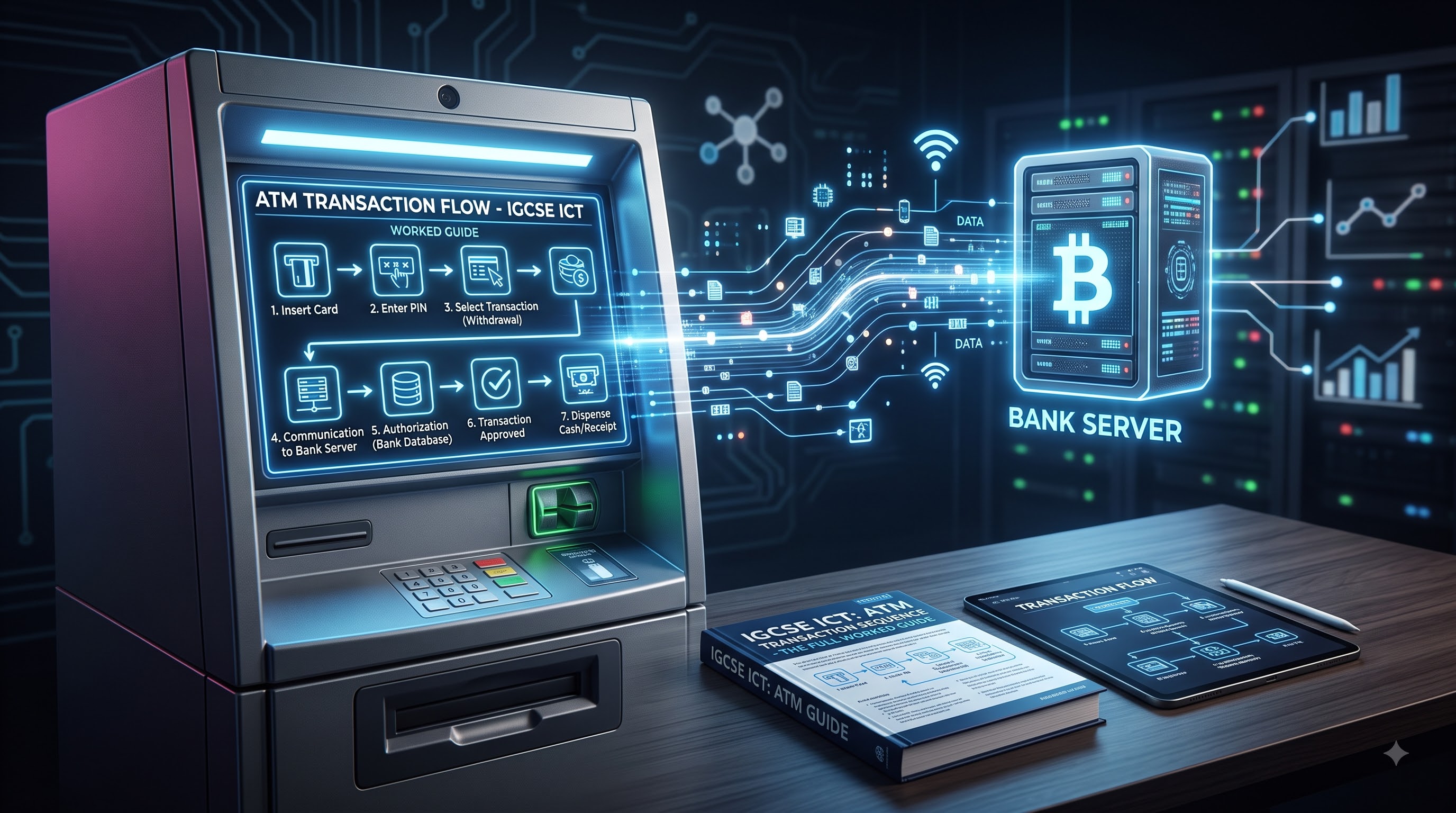
You get a six-mark "describe what happens during an ATM transaction" question, and you know every fact on the page. You know the PIN gets checked. You know the account gets checked for funds. You know the card comes back out at the end. You still drop two marks. Not because anything you wrote was wrong, but because you put the invalid-card check before the PIN check, or you jumped straight from "insert card" to "enter PIN" without the machine ever contacting the bank's computer in between.
Cambridge IGCSE ICT (0417) examiners mark the ATM transaction sequence on order, not just facts. That's the part almost nobody tells you until after the exam.
Quick checklist before you write a "describe the ATM transaction" answer:
-
Card inserted, then contact made with the bank's central computer, in that order
-
PIN checked against the stored PIN before anything else happens
-
Card validity checked separately from the PIN (not expired, not stolen, not blocked)
-
Funds and the daily limit checked together as one step, not two separate ones
-
Account updated in real time, not "at the end of the day"
What Actually Happens During an ATM Transaction?
An ATM transaction is a fixed sequence of checks a bank's computer system runs before it lets go of any cash. The machine verifies the card, checks the PIN, confirms the account holds enough money within the daily limit, then authorises and dispenses. Every one of those steps is a form of Electronic Funds Transfer (EFT): money moving directly between computer systems, with no physical cash involved until the very last step, when the machine actually counts out the notes.
That's the definition mark schemes want. What they actually test is whether you can put those checks in the right order and explain what happens when one of them fails.
What Are the Exact Steps in the ATM Transaction Sequence?
Examiners give marks for the right order, not just the right facts. Write every fact correctly but swap two steps, and you can still lose marks on an otherwise solid answer. Here's the sequence Cambridge IGCSE ICT (0417) expects:
-
The customer inserts their card into the ATM.
-
The ATM contacts the bank's central computer system.
-
The customer enters their PIN on the keypad.
-
The bank's computer checks the PIN entered against the PIN stored for that card.
-
The system checks whether the card itself is valid: not reported stolen, not expired, not blocked.
-
If the card is invalid, or too many incorrect PIN attempts have been made, the transaction closes immediately and the machine may retain the card.
-
If both checks pass, the customer sees a menu: check balance, withdraw cash, pay a bill, deposit a cheque, or change PIN.
-
If the customer chooses to withdraw cash, they select a preset amount or type in a different one.
-
The bank's computer checks the account for sufficient funds and confirms the withdrawal won't exceed the customer's daily limit.
-
If funds are sufficient and the limit isn't exceeded, the transaction is authorised.
-
The machine counts out the cash and asks the customer whether they want a receipt.
-
The card is returned, the cash is dispensed, and the account is updated in real time to reflect the new balance.
Notice steps 4 and 5 are two separate checks: is the PIN right, and is the card itself even allowed to be used. Students often collapse these into one "the card gets checked" step. That's an easy mark to drop.
What Is EFT, and How Does It Connect to an ATM Withdrawal?
Electronic Funds Transfer (EFT) is the direct transfer of money between bank accounts using computer systems, with no physical cash or cheques changing hands during the transfer itself. An ATM withdrawal is EFT in action: the moment the bank authorises the transaction, funds are deducted electronically from the customer's account. The cash the machine hands over afterwards isn't the transfer. It's just the visible result of one that already happened electronically.
Why Do Banking Systems Update Accounts in Real Time?
Account records have to update the instant a transaction is authorised. If they didn't, two transactions against the same balance could both get approved before either was recorded, a problem known as double-booking. Picture someone withdrawing cash from two different ATMs seconds apart under a system that only synced overnight: both withdrawals could succeed even though the account only held enough money for one.
How Does an ATM Transaction Compare to EFTPOS and Chip-and-PIN?
An ATM transaction, an EFTPOS payment (Electronic Funds Transfer at Point Of Sale, the system retailers use for card payments), and a chip-and-PIN purchase (a two-factor check using the card's chip plus a typed PIN) are all forms of EFT, and they share the same basic logic: verify the card, verify the PIN, check the funds, then authorise. Where they differ is where the transaction physically happens and what it hands over at the end, which is exactly the distinction Cambridge and Edexcel like to test with "state one difference" questions.
Method
Where it happens
What is exchanged
Typical use
ATM transaction
Cash machine, bank's own network
Physical cash dispensed after electronic transfer
Withdrawals, balance checks, PIN change
EFTPOS
Retailer's card terminal
No cash; funds move from customer to retailer
Paying for goods in a shop
Chip-and-PIN
Any terminal, chip plus typed PIN
Two-factor authentication of the payer
In-person retail payments
Contactless / NFC
NFC terminal, tapped not inserted
Low-value payment, no PIN needed
Fast, low-value purchases
What Are the Advantages and Disadvantages of ATM and EFT Banking?
ATMs and EFT let customers withdraw cash or make payments at any hour without visiting a branch, and transactions process faster and cheaper for banks than handling physical cash or cheques. The trade-off is security: isolated ATMs are a theft target, PINs can be "shoulder surfed," and EFT can't fully verify who's on the receiving end of a transfer, which makes reversing fraud slow.
That trade-off is exactly what a "discuss" or "evaluate" question wants you to weigh. Listing only the convenience side, which is the side students find easiest to write about, usually caps the answer well below full marks.
Advantages:
-
Cash can be withdrawn, and EFT payments made, at any hour, without a trip to a branch.
-
Transactions process quickly and cost banks less to handle than physical cash or cheques.
Disadvantages:
-
Isolated or poorly lit ATMs are a theft target, including "shoulder surfing" someone's PIN, and some machines charge a withdrawal fee.
-
EFT can't fully confirm who's actually on the receiving end of a transfer, and undoing a fraudulent one takes a formal investigation, not an instant reversal.
Worked Example: Tracing a £150 Withdrawal Through the Sequence
Here's how the sequence above plays out with real numbers. Aisha has £420 in her account and a daily withdrawal limit of £300. She wants £150 in cash.
-
Aisha inserts her card. The ATM contacts her bank's computer.
-
She enters her PIN. The system checks it against her stored PIN and confirms it's correct.
-
The system checks her card is valid; it's not expired or reported lost, so the transaction goes ahead.
-
She selects "Withdraw Cash" from the menu, then types in £150 instead of picking a preset amount.
-
The bank's computer runs two checks at once: does she have at least £150 in the account (yes, she has £420), and would withdrawing £150 push her over her £300 daily limit (no, since she hasn't withdrawn anything else that day)?
-
Both checks pass, so the transaction is authorised.
-
The machine counts out £150 and asks if she wants a receipt.
-
Her card is returned, the cash is dispensed, and her balance updates in real time to £270.
Now change one number. Say Aisha had already taken out £200 earlier that day and comes back for another £150.
Step 5 fails this time, and it's not because her balance is too low; £420 minus £350 is still £70 in the black. It fails because £200 plus £150 is £350, and £350 is more than her £300 daily limit.
That distinction, exceeded the daily limit versus insufficient funds, is the difference between a full-mark answer and a partial one. Examiners set questions specifically to catch students who write "declined because she didn't have enough money" when the real reason is the limit.
What Mistakes Cost Marks in ATM Transaction Answers?
-
Reversing steps 4 and 5, or merging the PIN check and the card validity check into one step.
-
Writing "insufficient funds" when the real reason for a decline is the daily limit, or the other way round.
-
Saying the account updates "at the end of the day" or "overnight" instead of in real time.
-
Skipping the "ATM contacts the bank's computer" step entirely and jumping straight from card insertion to PIN entry.
-
Treating EFT and "the cash coming out" as the same event, rather than the electronic transfer being what actually happens first.
How Do Exam Questions Actually Phrase This?
The command term tells you what shape the answer needs, and it's worth reading twice before you start writing.
-
"Describe the stages in an ATM transaction" wants the sequence, in order, whether that's numbered or in prose. This is where sequencing marks live.
-
"Explain why the account balance must be updated immediately" wants the double-booking mechanism, not just "so the balance is accurate."
-
"State one difference between an ATM transaction and an EFTPOS transaction" wants one clean contrast, usually cash dispensed versus no cash, not a full paragraph.
-
"Compare ATM and chip-and-PIN transactions" wants both a similarity and a difference, weighted to match the marks on offer.
If you want to see exactly how this gets phrased on a real paper rather than in a summary like this one, the Question Bank has topic-filtered past paper questions on banking applications, so you're practising the actual wording examiners use.
For a related IGCSE ICT topic that also leans on a strict, ordered decision-making process, our guide to expert systems and how they generate a diagnosis is worth a read.
How Should You Revise the ATM Transaction Sequence?
Don't just reread the sequence. Write out all twelve steps from memory, cover the page, then check it against this guide. Do it again with the numbers changed, the way the Aisha example does, so you're not just pattern-matching an order but actually thinking through what each check is for.
If an "explain" question keeps tripping you up, or you want a second opinion on how you've phrased a written answer, the AI Tutor can mark it against the same logic examiners use and tell you exactly where the marks dropped.
A note on where this comes from: this sequence follows the standard Cambridge IGCSE ICT (0417) "Banking applications" model, compiled from course material rather than lifted from one specific past paper diagram. Mark schemes shift slightly by session and by board, so cross-check the exact wording against your own syllabus before relying on it word for word.
FAQ
Q: What is EFT in IGCSE ICT? A: EFT stands for Electronic Funds Transfer: the direct movement of money between bank accounts using computer systems, with no physical cash or cheque involved in the transfer itself. ATM withdrawals, EFTPOS payments, and chip-and-PIN purchases are all examples of it.
Q: What happens if you enter the wrong PIN at an ATM? A: The bank's computer checks it against the PIN stored for that card. If it doesn't match, the transaction stops there. After a set number of failed attempts (usually three), the system closes the transaction and may keep the card.
Q: Is chip-and-PIN the same thing as EFT? A: Chip-and-PIN is a form of EFT, not a separate thing. It's a two-factor method, the chip plus a typed PIN, that confirms who's paying before an EFT transaction gets authorised, whether that's at an ATM or a shop's card terminal.
Q: What's the difference between an ATM transaction and an EFTPOS transaction? A: Both run on the same verify-then-authorise EFT logic. The difference is what happens at the end: an ATM transaction finishes with physical cash dispensed, while an EFTPOS transaction moves funds electronically from customer to retailer with no cash changing hands at all.
Q: Which exam boards test the ATM transaction sequence? A: Cambridge International (CAIE) IGCSE ICT (0417) tests it directly under "Banking applications." Edexcel International GCSE ICT covers the same EFT ideas under e-commerce and security, though the exact sequence wording in the mark scheme can differ between boards.