Cambridge vs Edexcel A Levels: Key Differences Uncovered
Discover the essential differences between Cambridge and Edexcel A Levels, including assessment structures, syllabus depth, and university recognition. Choose the best fit for your educational path with confidence!
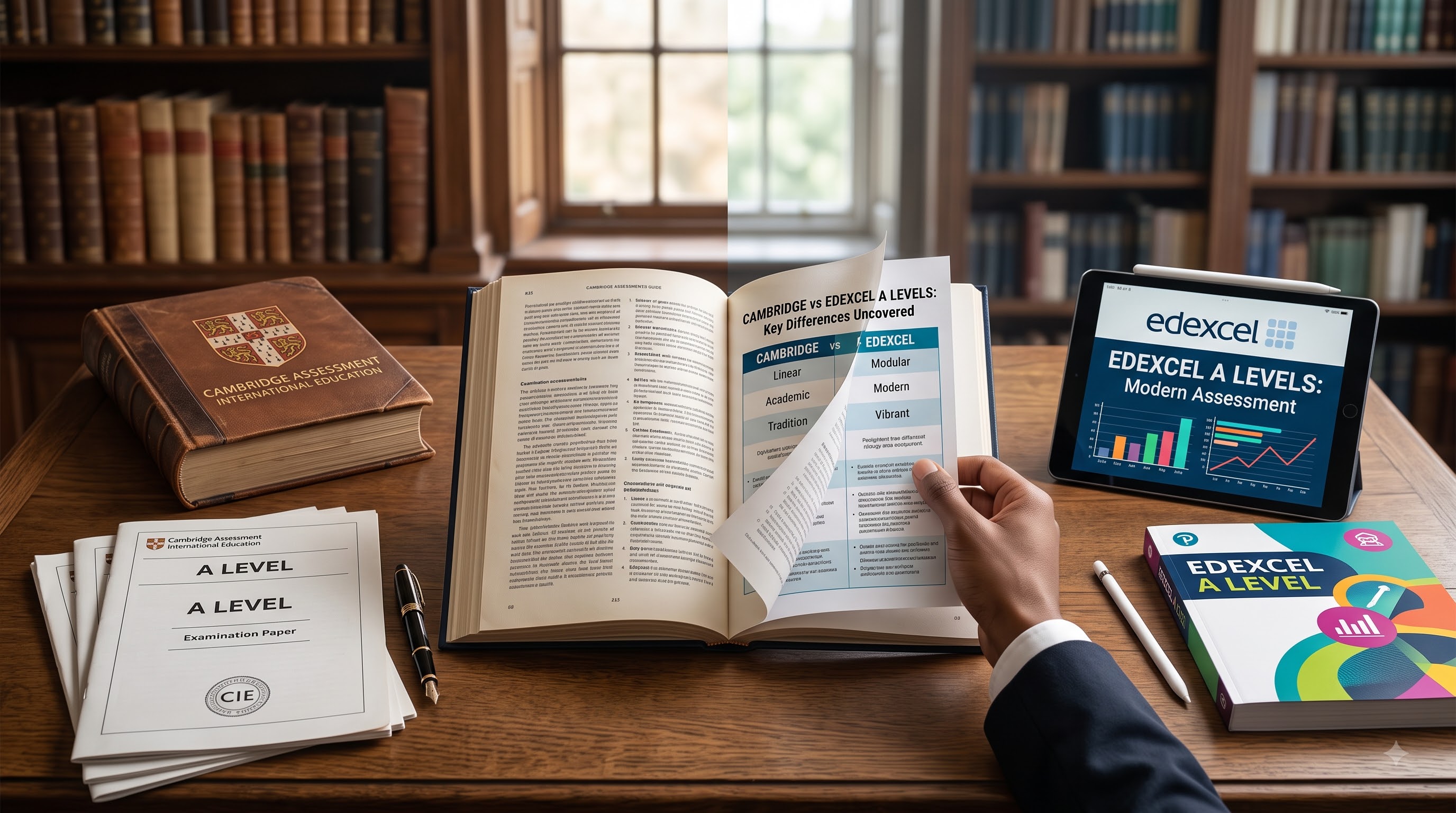
Choosing the right pre-university path is a big step for high school students. It matters even more if you plan to apply to university. One of the most common choices is between Cambridge and Edexcel.
If you want a clear A Level exam board comparison, this guide is for you. It looks at exam style, syllabus depth, grading, and study support. It also helps you choose a board that fits your learning style.
Note: This guide is about Cambridge and Edexcel A Levels, not Cambridge A Levels versus Singapore O Levels or Cambridge versus Singapore O Levels. If your school runs Edexcel IGCSE and A Levels on the same track, ask how each stage is taught.
Understanding the Giants: CAIE vs Edexcel
Before you compare cambridge a level vs edexcel, it helps to know who they are.
Cambridge Assessment International Education (CAIE) is part of the University of Cambridge. It is known for strong academic standards and a long history.
Pearson Edexcel is the UK's largest award body. It is known for a more set exam style and a clear structure.
For international students, it also helps to know the Edexcel International A Level vs GCE split. The UK GCE is now linear because of UK education reform. The Edexcel International A Level still uses a modular layout, which suits global students.
The Core Difference: Modular vs Linear A Level Assessment Structure
The biggest difference in the caie vs edexcel debate is how the exams are set.
- Cambridge (Linear): You study AS Level content and sit the exams at the end of year one. Then you do the same for A2 at the end of year two. Some students sit all AS and A2 papers at the end of the two-year course.
- Edexcel (Modular): The syllabus is split into units. You take an exam for each unit as soon as you finish that part of the work.
This modular vs linear A Level structure changes how students revise. Edexcel gives more room to resit units for a better grade. If you do poorly in one Chemistry unit, for example, you can retake that paper without repeating the whole subject.
Edexcel also offers a January exam series, along with May/June and October/November. That extra choice can reduce stress. Cambridge students usually have only the May/June and October/November windows.
Syllabus Depth and Subject-Specific Differences
A common question is which board is harder for A Level sciences. The honest answer is that both are hard, but they test different strengths.
Many teachers say the Cambridge international A Level syllabus goes deeper. CAIE sciences, such as Biology, Chemistry, and Physics, often require more memory work, a strong theory base, and tough multiple-choice papers. Cambridge also asks students to do hands-on practical exams in a lab for AS Level.
Edexcel sciences focus more on practical use, data analysis, and complex calculations. Instead of a live lab practical, Edexcel international students take a written Alternative to Practical paper.
There are also subject-level differences in A Levels beyond science. In Mathematics, for example, Edexcel splits mechanics, statistics, and decision maths in a different way from Cambridge. That gives some students more room to play to their strengths.
University Recognition and Grading
When it comes to CAIE vs Pearson Edexcel university recognition, you do not need to worry. Both boards are respected and treated the same by universities.
Whether you are applying to Oxford, MIT, the University of Toronto, or the National University of Singapore, both credentials hold the same weight.
They also carry the same UCAS tariff points for international A Levels. So an A* in Cambridge is worth the same as an A* in Edexcel. In most cases, university entry pages simply ask for "A Levels" or "International A Levels" and do not name a board.
If you are curious about how international A Level grades are moderated, both boards use strict scaling systems to keep results fair. Edexcel uses the Uniform Mark Scale (UMS) to make sure a tough exam session is scaled fairly. Cambridge uses grade boundaries that are set after the linear papers are marked.
Practical Considerations for Students
Your final choice often comes down to day-to-day study habits and school support.
- Study resources: Revision depends a lot on past papers and mark schemes. Because CAIE has been running internationally for a longer time under its current structure, you may find a larger bank of older past papers online. Edexcel, though, gives detailed examiner reports that show where students lose marks, which is very helpful for revision.
- Switching mid-course: Can you mix and match? Some universities may allow it, but it is usually not a good idea. The syllabuses do not match well. You risk missing key topics or needlessly repeating content. It is usually best to stay with one board for the whole subject.
- Self-studying: If you study outside a normal school, you may wonder which board works best. Many private candidates and homeschoolers prefer Edexcel. Its modular setup and January exam series let students move at a steady pace, one unit at a time.
Quick Actionable Tips for Making Your Choice
- Check your exam style: Do you do well in one big exam at the end of the year, or do you prefer smaller tests through the year?
- Check local exam centre access: Not every centre or British Council office offers both boards. Make sure the board you want is available in your city.
- Talk to your subject teachers: Many school choices are based on the teaching staff's knowledge of each board's mark schemes. Their advice can save you time.
The Final Takeaway
To wrap up, neither board is clearly "better" or "easier." Your success depends on how you learn, how you handle exam pressure, and how you plan your revision. Both Cambridge and Edexcel offer a strong, global standard that can prepare you well for university.
Q&A
Question: Which board is better for students who want more flexibility with exam timing?
Short answer: Edexcel IAL is usually more flexible because it uses a modular structure and offers January, May/June, and October/November exam sessions. Students can sit exams unit by unit and retake single papers if needed, instead of repeating a whole subject. Cambridge is less flexible because it follows a more linear model and usually offers May/June and October/November exam windows.
Question: Are Cambridge A Levels harder than Edexcel A Levels?
Short answer: Not always. The article's main point is that neither board is clearly "better" or "easier." Cambridge is often tied to deeper theory, more memory work, tough multiple-choice papers, and hands-on science practicals. Edexcel can also be demanding, especially in data analysis, practical use, and complex calculations. The difficulty depends on the student's strengths and preferred assessment style.
Question: Do universities prefer Cambridge over Edexcel, or vice versa?
Short answer: No. Universities usually treat Cambridge and Pearson Edexcel A Levels the same. Both are well known, carry the same UCAS tariff points, and are accepted by top universities such as Oxford, MIT, the University of Toronto, and the National University of Singapore. Admissions pages usually ask for "A Levels" or "International A Levels" without naming a board.
Question: Is it a good idea to switch from Cambridge to Edexcel midway through A Levels?
Short answer: It is usually not recommended. Some universities may allow mixed credentials, but the syllabuses do not line up well. Switching mid-course can create gaps in knowledge or cause students to repeat content needlessly. For one subject, it is usually best to finish both AS and A2 with the same board.
Question: Which board is more suitable for independent learners or private candidates?
Short answer: Edexcel is often a better fit for independent learners because its modular structure lets students study and sit exams one unit at a time. The January exam series also helps private candidates spread out the load and plan resits more easily. Cambridge can still work for independent study, but its linear structure may need stronger long-term planning.