Choosing Between IB and A Levels: Key Differences
Deciding between IB vs A Levels: Which Is Right for Your Child? Explore the difference between IB and A Levels to choose the best fit for your teenager's education and university goals.
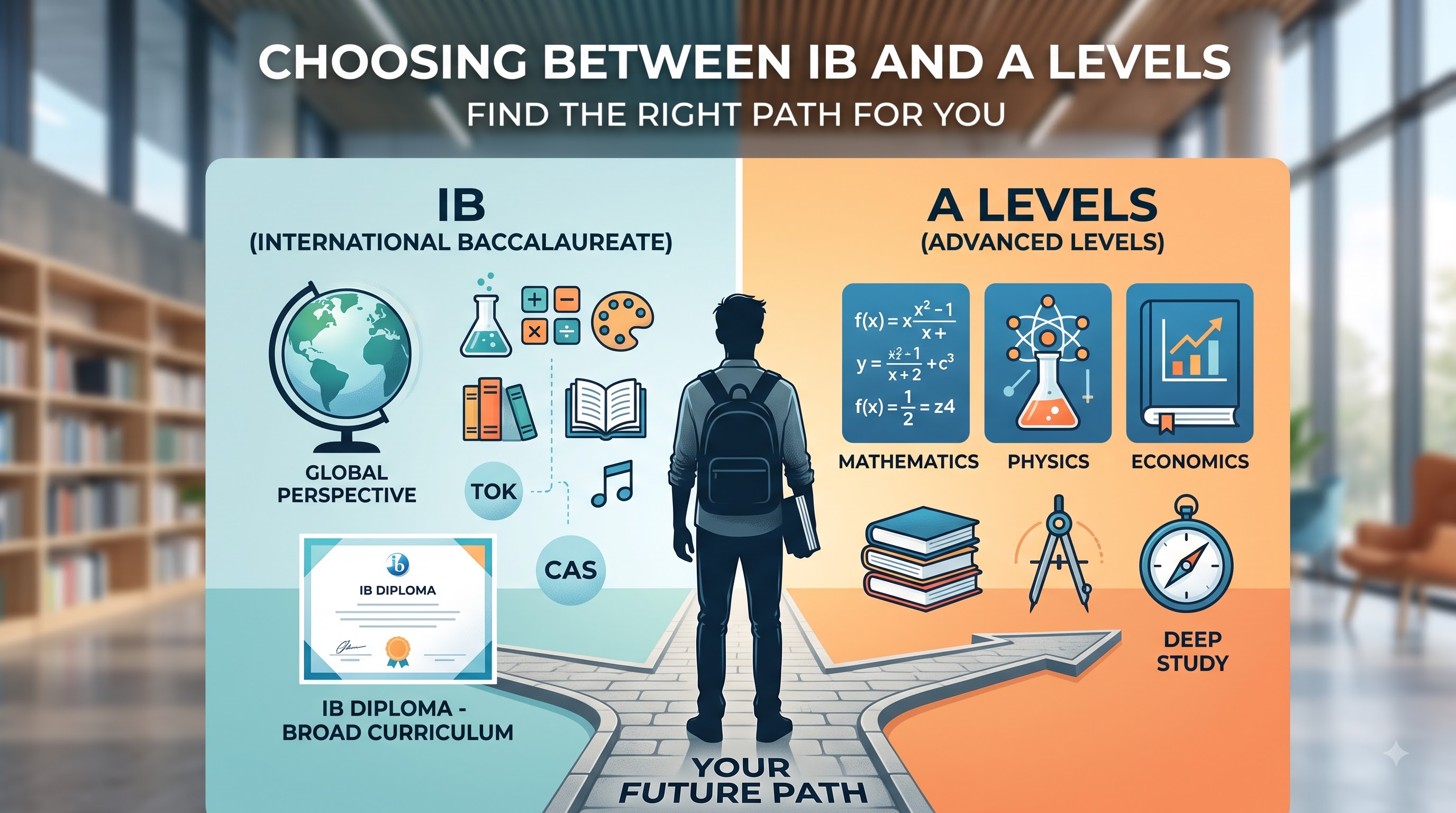
As your teenager approaches the final two years of high school, you are likely facing one of the most critical educational decisions of their academic journey: IB vs A Levels: Which Is Right for Your Child? This choice dictates not only what they will study, but exactly how they will learn, ultimately shaping their university prospects and future career paths.
Both pathways are globally respected, rigorous, and capable of unlocking doors to top-tier universities. However, they cater to fundamentally different types of learners. If you are struggling to make this choice, let’s break down everything you need to know to make an informed, confident decision.
Understanding the Core Educational Philosophy
The most significant difference between ib and a levels lies in their educational design. The UK-based Advanced Level (A Level) system is built on the concept of deep specialization. Students typically choose three (sometimes four) subjects to study in incredible depth over two years.
Conversely, the International Baccalaureate (IB) Diploma Programme mandates a comprehensive approach. It requires students to take six subjects across various disciplines—including a first language, a second language, humanities, sciences, and mathematics.
When comparing the breadth of study in ib curriculum vs a levels, the IB intentionally forces students out of their academic comfort zones. Meanwhile, the specialized learning advantages of a levels allow students to laser-focus entirely on their strengths. If a student excels in science but struggles with essay writing, A Levels allow them to drop English and History entirely.
Curriculum Breakdown: Specialists vs. Generalists
The A Level Pathway
A Levels are ideal for teenagers who already have a clear idea of what they want to study at the university level. When choosing a level subjects for competitive universities, students can tailor their selection to align perfectly with specific degree requirements. For example, a future medical student can focus entirely on Chemistry, Biology, and Mathematics.
When analyzing international baccalaureate vs a level for stem (Science, Technology, Engineering, and Mathematics), many students and educators prefer A Levels. This is because a teenager can dedicate 100% of their academic timetable and revision energy to quantitative, scientific subjects, providing a deeply focused foundation for engineering or physics degrees.
The IB Diploma Pathway
The IB Diploma requires students to choose three subjects at Higher Level (HL) and three at Standard Level (SL). Parents often wonder about the differences between ib hl and a level subjects. While A Levels dive slightly deeper into specific syllabus details due to the sheer amount of time dedicated to just three subjects, IB HL subjects are highly rigorous and generally viewed as comparable in difficulty.
What truly sets the IB apart is its mandatory "Core." The theory of knowledge and extended essay impact students profoundly by teaching them university-level research, critical thinking, and epistemology before they even graduate high school. Furthermore, the creativity activity service and student development component (CAS) ensures teenagers engage in extracurriculars, sports, and community service, fostering well-rounded individuals.
University Admissions and Global Recognition
A primary concern for any parent is the university recognition of ib vs a levels. Rest assured, both qualifications are heavily recruited by elite universities worldwide, from Oxford and Cambridge in the UK to the Ivy League in the United States.
However, when making a global university entrance requirements comparison, subtle preferences emerge. US universities often look highly upon the IB because its broad, multidisciplinary curriculum perfectly mirrors the American liberal arts college philosophy. Conversely, UK universities highly appreciate the deep, subject-specific knowledge that A Level students bring to their specialized degree programs on day one.
If your child is applying to British institutions, understanding the ucas tariff points for ib vs a level grades is essential. Both systems convert neatly into UCAS points. Universities often ask for specific A Level grades (such as A*AA) or an overall IB point score (such as a 38 out of 45). The IB’s wider point scale gives universities a slightly more granular way to assess candidates, though neither system provides an inherent "shortcut" to acceptance.
Workload, Stress, and Academic Rigor
A frequently asked question in parent-teacher meetings is: is the ib diploma harder than a levels? The short answer is that both represent the pinnacle of the academic rigor of high school qualifications, but the type of difficulty varies immensely.
A Levels are academically demanding because the content is dense. Furthermore, a student's final grades heavily depend on high-stakes examinations at the very end of the two-year course. If a student has a bad exam week, it can heavily impact their overall results.
The IB, on the other hand, is an academic marathon. It relies heavily on continuous assessment, including internal assessments (IAs), lengthy essays, and presentations throughout the two years, alongside final exams. Managing ib workload and stress is a vital skill for IB students, as they must balance six subjects, CAS requirements, and a 4,000-word Extended Essay. The IB isn't necessarily harder intellectually across the board, but the time-management and organizational demands are undoubtedly higher.
How to Decide on Sixth Form Curriculum
Understanding how to decide on sixth form curriculum ultimately comes down to your child’s unique learning style, interests, and personality. When weighing up ib vs a levels, consider these actionable guidelines:
-
Choose A Levels if your child:
-
Has a highly specific career path or university course in mind.
-
Strongly dislikes or struggles with certain subject areas (e.g., they hate math or foreign languages) and wants to drop them.
-
Thrives in a focused academic environment and prefers diving deeply into a few chosen subjects.
-
Performs well in high-stakes, end-of-year written examinations.
-
Choose the IB Diploma if your child:
-
Is an "all-rounder" who enjoys multiple disciplines and wants to keep their university options as open as possible.
-
Benefits from continuous assessment and coursework rather than relying solely on final exams.
-
Wants to experience the holistic education benefits of international baccalaureate, focusing on personal growth, global awareness, and independent research skills.
-
Has strong time-management skills to juggle multiple deadlines simultaneously.
Final Thoughts
When evaluating an ib diploma vs a level, it is crucial to remember that there is no definitive "better" option—only the option that is better for your teenager. Both are gold-standard educational frameworks that will equip your child with vital skills for higher education and the modern workforce.
Take the time to discuss these differences with your child, consult with their current teachers about their academic strengths, and consider the university destinations they are aiming for. By aligning their high school curriculum with their personal learning style, you will set them up for a successful, engaging, and fulfilling final two years of school.