How Do Horizontal, Vertical and Conglomerate Integration Differ?
Horizontal, forward and backward vertical, and conglomerate integration for IGCSE Business Studies, with worked examples and a table.
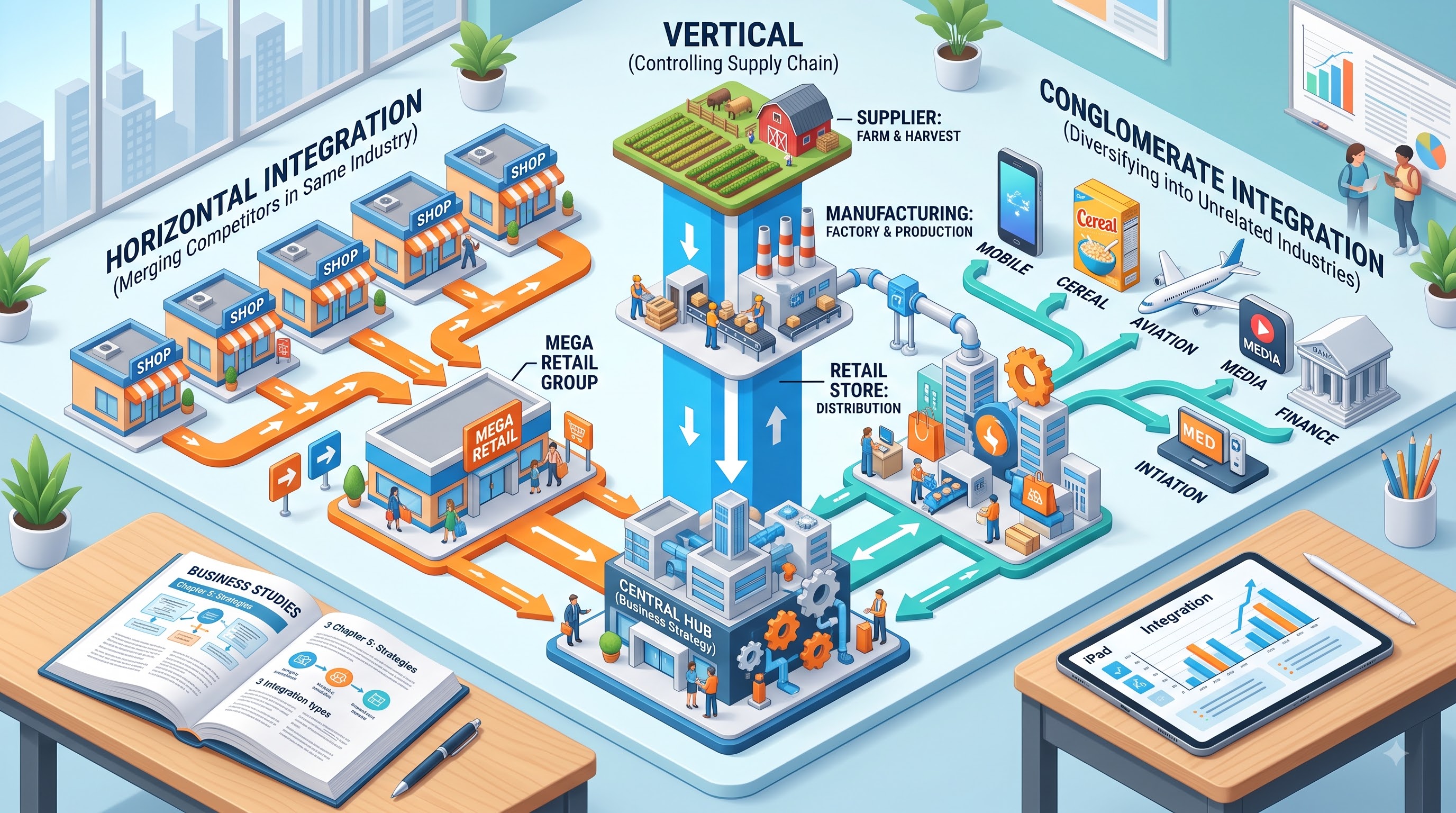
Horizontal, Vertical and Conglomerate Integration: How Do They Actually Differ? (IGCSE Business Studies)
What Is Business Integration, and Why Does It Come Up So Often in IGCSE Business Studies?
Integration is a form of external growth. A business expands by merging with or taking over another business, rather than growing internally (organic growth) by reinvesting profits into its existing operations. Examiners for CAIE Cambridge IGCSE Business Studies (0450) test this under "growth and evolution of businesses," and it shows up two ways: as a knowledge question ("define horizontal integration") and as an evaluation question ("recommend which type of integration a business should use").
There are two routes into external growth. A takeover is where one business buys a controlling stake in another, and the target becomes part of the "predator" business. A merger is where two businesses combine by mutual agreement. Integration is then classified by which stage of production, and which industry, the two businesses sit in.
Quick checklist before you attempt an integration question
-
Can you name which stage of production and which industry each business sits in, not just say "they merged"?
-
Do you know whether a scenario describes forward or backward vertical integration?
-
Can you give one benefit and one specific risk for the exact type in the question, rather than a generic list of all four?
-
If the question says "recommend" or "justify," do you know it wants a decision, not just definitions?
What Is Horizontal Integration?
Horizontal integration keeps both businesses in the same industry, at the same stage of production, doing more or less the same thing before the deal happens. Picture two chocolate manufacturers merging: same product, same customers, same suppliers, now under one roof instead of two.
The appeal is scale. Combining two same-stage rivals immediately increases market share, cuts the number of competitors in the industry, and opens up economies of scale: buying raw materials in bulk, spreading fixed costs like head-office overheads across a bigger output. The risk side is just as testable, and just as often forgotten. Managing a suddenly much larger workforce and set of sites is harder than it sounds, and growing too fast can tip a business into diseconomies of scale, where average costs start rising because of poor communication and coordination rather than falling because of scale.
What Is Vertical Integration, and What's the Difference Between Forward and Backward?
Vertical integration moves in a different direction entirely. Instead of merging with a rival, the business merges with another business in the same industry but at a different stage of production, and it goes one of two ways: forward, toward the customer, or backward, toward the raw material.
Forward vertical integration means merging with the next stage of production, closer to the final consumer. A chocolate manufacturer (secondary sector) taking over a chocolate shop (tertiary sector) is the textbook case. This secures a guaranteed retail outlet for the manufacturer's own output, lets the business absorb the profit margin the retailer would otherwise have kept, and gives direct access to information about what customers actually want, instead of hearing it second-hand.
Go the other direction and you get backward vertical integration: the same chocolate manufacturer taking over a cocoa farm instead. This guarantees a supply of an essential input, absorbs the supplier's profit margin, hands the business control over the cost and quality of that input, and can even be used to block a supplier from selling to rival manufacturers.
Here's the trap almost every student falls into: writing "vertical integration secures supply" for both directions. Only backward integration secures supply. Forward integration secures a market, an outlet for what you already make. Mix those two up and you can lose a mark on an otherwise perfect answer.
What Is a Conglomerate Merger, and Why Would a Business Diversify Into an Unrelated Industry?
Conglomerate mergers throw the "same industry" rule out entirely. A business merges with a firm doing something completely unrelated, a chocolate manufacturer merging with a photography company is the classic textbook pairing, and it's also called diversification.
There's no shared stage of production and no shared industry here, so the appeal isn't economies of scale. It's risk management. Operating across unrelated markets means a downturn in one industry doesn't sink the whole business, and occasionally ideas, management expertise or working capital transfer usefully between two very different sides of the same company.
Horizontal vs Vertical vs Conglomerate Integration: Comparison Table
Type
Definition
Worked example
Main benefit
Main risk
Horizontal
Same stage, same industry
Chocolate manufacturer takes over another chocolate manufacturer
Economies of scale; bigger market share; fewer competitors
Diseconomies of scale; harder to manage and control
Forward vertical
Next stage, toward the consumer, same industry
Chocolate manufacturer takes over a chocolate shop
Guaranteed outlet; absorbs retailer's profit margin
Business may lack retail experience
Backward vertical
Previous stage, toward raw materials, same industry
Chocolate manufacturer takes over a cocoa farm
Guaranteed supply; absorbs supplier's profit margin; controls input costs
Business may lack expertise in the new sector, e.g. farming
Conglomerate
Unrelated industry
Chocolate manufacturer merges with a photography company
Spreads and diversifies risk across industries
Little synergy; management stretched across unrelated fields
What Does a Full-Mark Answer to an Integration Question Actually Look Like?
Take this question: "Choco Ltd is a chocolate manufacturer. It is considering either (a) taking over a rival chocolate manufacturer, or (b) taking over a chain of chocolate retail shops. Recommend which option Choco Ltd should choose. Justify your answer."
Start by naming and defining both options correctly: option (a) is horizontal integration, option (b) is forward vertical integration. Then apply the benefits to Choco Ltd specifically instead of listing them generically. Horizontal would grow market share and open up economies of scale in ingredient buying, but risks diseconomies of scale if the combined firm is hard to coordinate. Forward integration would guarantee retail outlets for Choco Ltd's own chocolate and let it capture the margin the shops currently keep, though Choco Ltd has no track record running retail stores.
A full-mark answer picks one, ties the justification back to a stated business objective ("if Choco Ltd's priority is market share, horizontal integration is the stronger choice because..."), and acknowledges the trade-off. That's the evaluation examiners are grading for. Not knowing the definitions. Applying them.
If you want more of these recommend-and-justify scenarios to practise against a real mark scheme, the Question Bank has past paper questions filtered to exactly this topic.
What Problems Can Business Growth Through Integration Cause?
Growth by integration doesn't just add benefits; every route above carries real integration risk, and mark schemes reward answers that go beyond naming the problem.
Control gets harder as the business gets bigger. A clearer management hierarchy or stronger communication channels are the usual mitigations worth naming. Different working cultures can clash, which compromise or a redesigned management style can reduce. And the deal itself is expensive, which can leave the enlarged business short of cash unless financing was planned in advance. Naming the problem and a specific way to reduce it is what separates a Level 2 evaluation answer from a Level 3 one.
If you want to check whether your own recommendation would actually hit Level 3 rather than stall at Level 2, the AI Tutor can grade a written answer against the mark scheme directly, not just tell you the general idea was right.
Related reading on SortMyPrep: for how integration decisions connect to a business's stated aims, see our guide to business objectives and stakeholders.
FAQ
What is the main difference between horizontal and vertical integration? Horizontal integration merges two businesses at the same stage of production in the same industry, such as two chocolate manufacturers combining. Vertical integration merges businesses at different stages of the same industry, either forward toward the customer or backward toward the raw material.
What is the difference between forward and backward vertical integration? Forward vertical integration means taking over a business closer to the final consumer, such as a manufacturer buying a retail shop, which secures a sales outlet. Backward vertical integration means taking over a business closer to the raw material, such as a manufacturer buying a supplier or farm, which secures the supply of an input.
Is a merger the same thing as a takeover? No. A takeover is when one business buys a controlling stake in another business, which then becomes part of the "predator" business. A merger is when two businesses combine by mutual agreement. Both are forms of external growth, and integration (horizontal, vertical, conglomerate) describes the relationship between the two businesses involved, whichever method is used.
What is a conglomerate merger and why would a business choose it? A conglomerate merger is when a business merges with a firm in a completely unrelated industry, such as a chocolate manufacturer merging with a photography company. Businesses choose it to diversify and spread risk across industries, so a downturn in one market doesn't threaten the whole business.
Which exam board tests horizontal, vertical and conglomerate integration? This topic appears in CAIE Cambridge IGCSE Business Studies (0450), under the growth and evolution of businesses, or external growth, section of the syllabus.