IGCSE vs CBSE: Choosing the Right Path
Discover the key differences in the IGCSE vs CBSE debate. Understand how Cambridge vs CBSE impacts learning styles, curriculum, and career paths for your child.
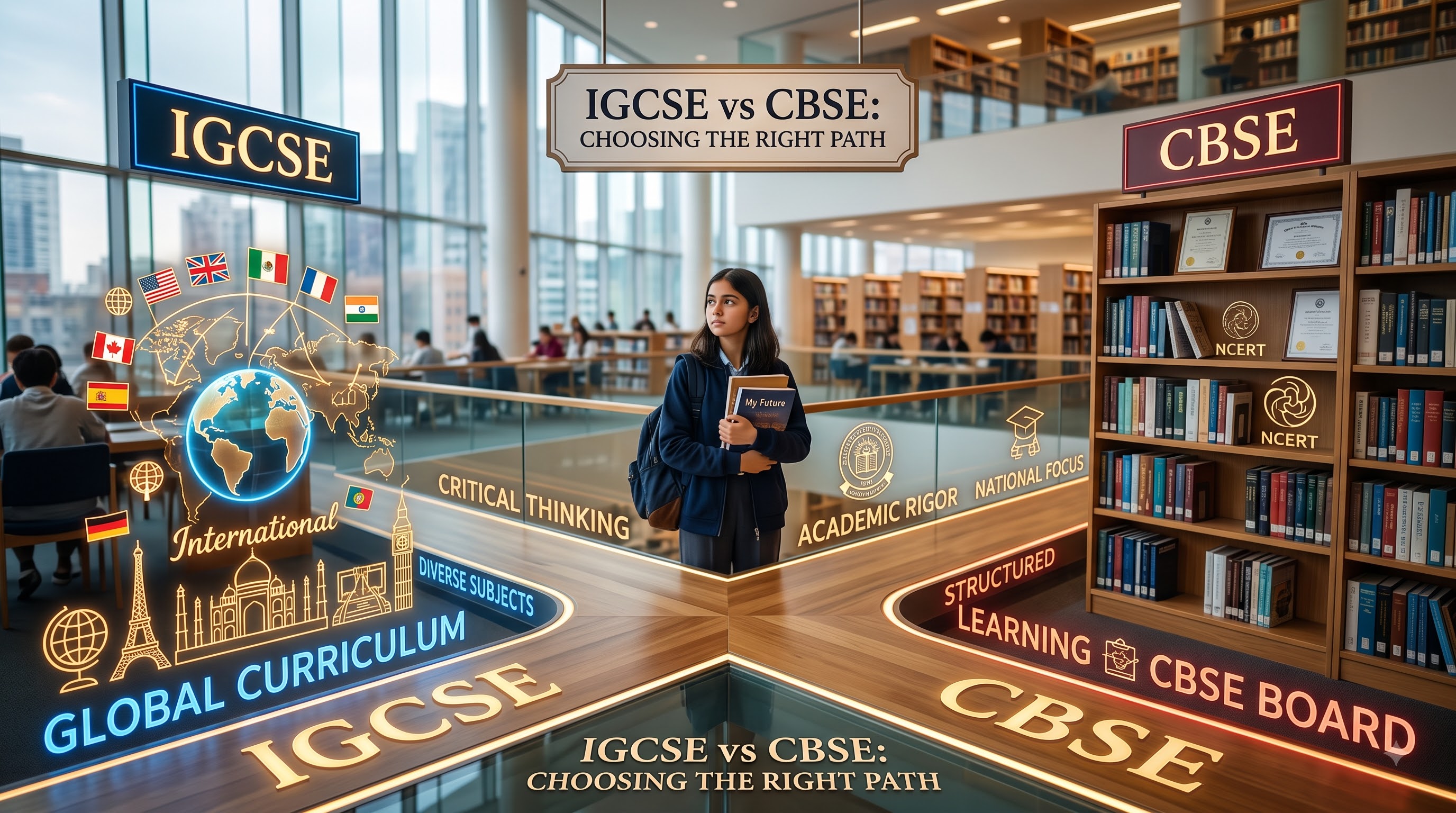
Choosing the right educational board for your child is one of the most crucial and overwhelming decisions you will make as a parent. If you find yourself caught in the classic IGCSE vs CBSE debate, you are certainly not alone. Both educational pathways offer robust, highly respected frameworks, but they cater to fundamentally different learning styles, academic goals, and future career plans.
Understanding the nuances of Cambridge vs CBSE is essential for setting your child up for long-term success. Let’s break down the facts, dispel the myths, and help you make a confident, informed choice for your child's academic future.
Understanding the Foundations
At the core of the difference between CBSE and Cambridge are their governing bodies and foundational philosophies.
The Central Board of Secondary Education (CBSE) is India’s national curriculum, designed to standardize education across the vast geographic expanse of the country. Conversely, the International General Certificate of Secondary Education (IGCSE) is an internationally recognized qualification.
When we evaluate Cambridge Assessment International Education vs NCERT (the body that designs the core CBSE syllabus), we are essentially comparing a globally oriented, flexible framework against a nationally tailored, highly structured one.
Curriculum Focus and Teaching Methodology
The most striking difference between CBSE and IGCSE lies in how students are taught in the classroom. If you look closely at the Cambridge syllabus vs CBSE, you will notice a distinct contrast in academic priorities.
-
Learning Approach: The Cambridge curriculum champions application-based learning vs theoretical knowledge. Students are continuously encouraged to ask "why" and "how," shifting the focus entirely away from rote memorization. CBSE, historically, has leaned more heavily toward ensuring students have a profound, theoretical grasp of core concepts.
-
Skill Development: Developing critical thinking skills in international education is a primary focus. IGCSE assessments require students to analyze data, evaluate evidence, and solve real-world problems. While CBSE has recently integrated more competency-based questions into its exams, the Cambridge curriculum vs CBSE comparison still highlights Cambridge as the global leader in nurturing independent, investigative skills.
Subject Choices and Academic Flexibility
When comparing subject choices in Cambridge IGCSE versus CBSE, the international board offers unparalleled freedom, which is a massive advantage for students with non-traditional academic interests.
-
Cambridge: There is immense IGCSE curriculum flexibility for subjects. Cambridge allows students to mix and match subjects across various disciplines. A student can comfortably study Physics, Art and Design, Business Studies, and French simultaneously.
-
CBSE: Traditionally, CBSE channels students into distinct, rigid streams (Science, Commerce, Humanities) after the 10th grade. Although India's New Education Policy (NEP) is gradually introducing more flexibility, CBSE is still a more structured, linear pathway.
Assessments, Grading, and Student Life
Parents must pay close attention to the difference in assessment and grading systems when making their choice, as this directly affects a child's daily life and study habits.
CBSE evaluates students primarily through standardized written board examinations, awarding grades based on a positional and marks-based system. IGCSE, however, evaluates students through a comprehensive mix of written, oral, coursework, and practical assessments, grading them on a scale from A* to G.
-
Student Well-being: Let's talk about student workload and stress levels in different boards. CBSE can become a high-pressure environment during board exam seasons due to the sheer volume of the syllabus that must be memorized and recalled. IGCSE, on the other hand, is consistently demanding year-round, requiring continuous research, essay writing, and project work.
-
The Adjustment Period: What is the difficulty level of the international curriculum for Indian students? For children used to textbook-heavy, lecture-style learning, moving to IGCSE can initially seem quite daunting. The exams are highly unpredictable and test applied knowledge, meaning students cannot simply memorize previous years' question papers to pass.
Aligning with Future Goals: University and Careers
Your choice in the Cambridge board vs CBSE discussion should closely align with your child's higher education aspirations.
Planning to Study Abroad?
If you are wondering which board is better for overseas university admissions, the answer strongly leans toward IGCSE. It boasts immense global recognition of secondary school certificates, making it a familiar, trusted, and highly valued qualification for admissions officers at top universities in the UK, US, Canada, and Australia.
Planning to Stay in India?
Conversely, the CBSE syllabus for competitive exams like JEE and NEET is absolutely unmatched. If your child plans to pursue engineering or medicine in India, CBSE is hands-down the better choice because these hyper-competitive Indian entrance exams are strictly mapped to the NCERT curriculum.
Furthermore, you must consider university entrance requirements for domestic vs international boards. Indian universities seamlessly process CBSE scores. While students applying to Indian colleges with Cambridge certificates are widely accepted today, they occasionally need to secure an equivalence certificate from the Association of Indian Universities (AIU), adding a minor administrative step.
Ultimately, the impact of board selection on career prospects depends on the pathway your child takes. CBSE produces resilient students with incredible discipline and foundational clarity, perfect for highly technical Indian institutions. Cambridge produces adaptable, independent learners ready for global, diverse workplaces.
Practical Considerations for Parents
Before finalizing your decision, there are a few practical, logistical elements you need to weigh:
-
Financial Investment: Budget is a vital factor. When doing a school fee structure comparison for international boards, you will find that Cambridge-affiliated schools generally charge significantly higher fees than standard CBSE schools. This is due to specialized teacher training, smaller class sizes, superior infrastructure, and international licensing fees.
-
Changing Lanes: What if you want to switch boards midway? Transitioning from national to international curriculum is highly feasible, but timing is everything. Moving from CBSE to IGCSE is relatively seamless in the primary or middle school years (grades 5 through 8). However, transitioning during high school (grade 9 or 11) can cause immense stress due to the sudden shift in assessment styles and baseline expectations.
Actionable Tips for Making Your Decision
-
Assess Your Child's Learning Style: Does your child thrive on clear instructions and structured reading? CBSE might be a safer bet. Do they get bored easily and love asking questions or doing hands-on projects? IGCSE will keep them engaged.
-
Define the 5-Year Goal: Sit down and honestly discuss university plans. If IIT or AIIMS is the ultimate dream, stick to CBSE.
-
Tour the Schools: Don't just look at the curriculum on paper. Visit both CBSE and Cambridge schools in your city. Observe the classrooms, look at the science labs, and talk to the faculty about their teaching methodologies.
The Final Verdict
To summarize the great IGCSE vs CBSE debate: there is no universal "best" board, only the best board for your child.
Choose CBSE if you want a robust, standardized education that prepares your child rigorously for Indian competitive exams at a more accessible price point. Choose IGCSE if your budget allows it and you want to prioritize global exposure, creative subject flexibility, and a much smoother pathway to prestigious international universities. By aligning the curriculum with your child's unique strengths and future goals, you ensure their educational journey is both successful and deeply fulfilling.